
One of the biggest misconceptions I come across is that if an RCD keeps tripping, there must be something wrong with the wiring. That's not always the case.
I recently carried out an Electrical Installation Condition Report (EICR) at a property in Burnham-on-Sea after a customer contacted me because the socket circuit kept tripping whenever all four of the free-standing fans she'd bought were running together.
I'd actually visited the property previously and, rather than guessing at the cause or replacing parts unnecessarily, I recommended carrying out a full EICR. It's the best way to establish whether the issue lies with the fixed wiring, an appliance, or something else entirely.
Why did I recommend an EICR instead of trying to fix the tripping? Because nuisance tripping can be caused by several different things.
It could be damaged wiring, deteriorating insulation, a faulty appliance, a damaged socket, or simply the combined effect of several appliances operating at once. Without proper inspection and testing, it would only be guesswork.
A full EICR allows me to assess the condition of the installation and identify the real cause before recommending any work.
What did the inspection find?
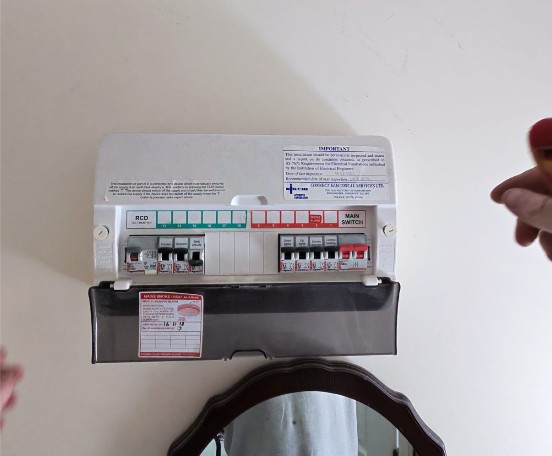
The electrical installation tested extremely well.
Insulation resistance readings were satisfactory, polarity was correct, earth continuity was good and the protective devices operated exactly as they should. There were no signs of deterioration or faults within the fixed wiring.
I also checked the customer's fans individually.
Each fan operated perfectly on its own.
That immediately ruled out both the installation and a single faulty appliance.
So why did the socket circuit keep tripping?
The answer was combined earth leakage.
Every electrical appliance leaks a tiny amount of current to earth during normal operation. Modern appliances with electronic power supplies and suppression filters all contribute a small amount, and individually this isn't normally a problem.
However, when several appliances with their own small earth leakage currents are running together on the same circuit, those leakages add together.
In this property, the entire house socket circuit was protected by a single RCD. Once all four fans were switched on alongside the other appliances already plugged in around the house, the combined earth leakage became high enough for the RCD to operate exactly as it was designed to.
Nothing was faulty.
The protective device was simply doing its job.
Was the electrical installation safe?
Yes.
One of the benefits of carrying out a proper EICR is being able to distinguish between a genuine electrical fault and normal operation.
There was no evidence of damaged wiring, failing insulation or unsafe connections that would explain the tripping. The inspection confirmed that the installation itself was in good condition.
As electricians, we don't always find faults. Sometimes our job is to prove that everything is working correctly and explain why something is happening.
What advice did I give the customer?
Rather than replacing equipment or carrying out unnecessary work, I suggested a simple change to how the fans were used.
During the day, when she's downstairs, use the downstairs fans.
When going upstairs to bed, switch those off and use the upstairs fans instead.
By avoiding having all four fans running together, the overall earth leakage on the socket circuit is reduced while still keeping the house cool during the warmer weather.
It's a simple solution that costs nothing and completely avoids unnecessary electrical work.
What was the outcome?
The customer was understandably pleased to learn there wasn't a fault with the wiring.
Instead of paying for repairs that weren't needed, she now understands exactly why the RCD was tripping and has a straightforward way of preventing it happening again.
Just as importantly, she now has a Satisfactory Electrical Installation Condition Report (EICR) confirming that the fixed electrical installation was safe at the time of inspection.
For an owner-occupied property, an EICR is typically recommended every 10 years, so she now has documented evidence that her home's electrics have been professionally inspected. That can be useful for insurance purposes, when selling the property, or simply for the reassurance of knowing the installation has been checked by a qualified electrician.
Sometimes the best outcome isn't finding a fault—it's giving a homeowner confidence that their electrics are safe and explaining the situation in a way that makes sense.
Frequently Asked Questions
Can an RCD trip even if nothing is broken?
Yes. Several appliances can each produce a small amount of earth leakage. When enough are used together, the total leakage can reach the operating threshold of the RCD even though every appliance and the wiring are working correctly.
Does an RCD tripping always mean there's a fault?
No. While it should never be ignored, nuisance tripping isn't always caused by faulty wiring. Professional testing is the best way to identify the real cause.
Is an EICR worth having if everything passes?
Absolutely. A satisfactory EICR confirms that the electrical installation has been professionally inspected and tested. It provides reassurance, creates a record of the installation's condition and may be useful for insurance, future buyers and general peace of mind.
Need an EICR in Burnham-on-Sea?
If your electrics keep tripping, don't assume the wiring is faulty—and don't ignore it either. A professional inspection can identify whether the issue lies with the installation, an appliance or simply the way your electrical equipment is being used.
I carry out Electrical Installation Condition Reports (EICRs) throughout Burnham-on Sea, Highbridge, Berrow, Brent Knoll, Bridgwater and the surrounding Somerset villages, providing clear explanations, honest advice and practical solutions based on proper testing—not guesswork. Get in touch today!